
Dr. Irina Timm - Projects
Affective well-being, physical behaviour, and contextual factors in everyday life
Research approach
In our research, we use wearable devices to examine how physical behavior and affective states are related in everyday life. Our studies focus on within-subject associations between physical behaviour and affective well-being, as well as on the role of contextual factors such as weather.
The overarching aim is to understand how these relationships unfold under real-world conditions and how they vary across situations encountered in daily life.
Project 1: Physical behavior and affective well-being in everyday life
Timm, Irina, et al. "The Within-Subject Association of Physical Behavior and Affective Well-Being in Everyday Life: A Systematic Literature Review" Sports Medicine 54.6 (2024): 1667-1705.
In this systematic review, we synthesized evidence from 66 ambulatory assessment studies examining within-subject associations between physical activity, sedentary behavior, and affective well-being in daily life. By focusing on intensive longitudinal designs across diverse populations and age groups, the review integrates findings from studies that repeatedly assessed behavior and affect under real-world conditions. A central methodological feature is the use of wearable and mobile technologies—such as accelerometer-based activity trackers and smartphone-based ecological momentary assessment (EMA)—which enable continuous or high-frequency measurement of physical behavior alongside in situ affect assessment. This approach provides unique insights into short-term and momentary processes that are not accessible in laboratory or cross-sectional research.
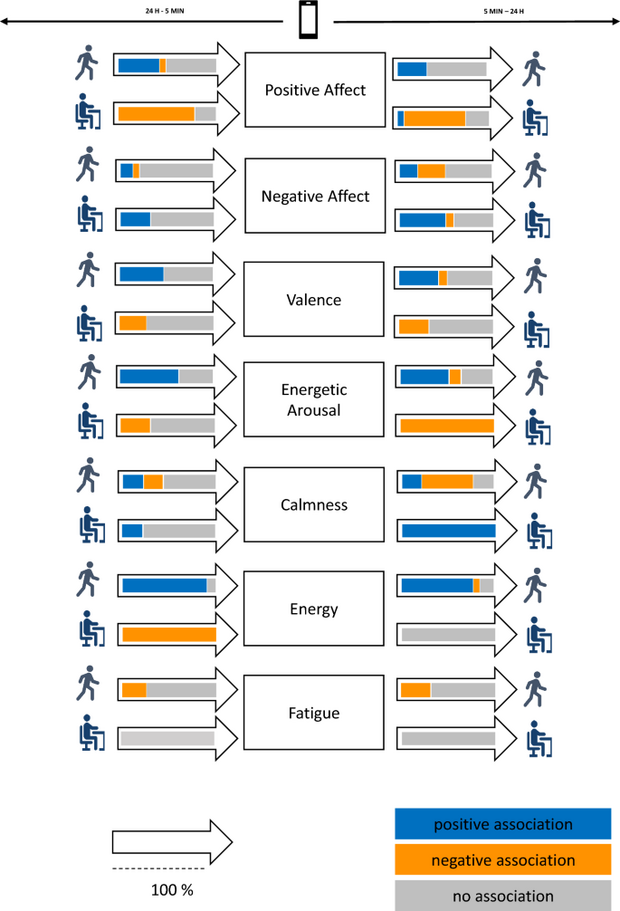
Overall, the evidence suggests that even short bouts of physical activity tend to be associated with more positive affective states. In particular, associations with higher energy (arousal) and more positive valence appear relatively consistent across different samples and measurement approaches. The accompanying figure provides a graphical synthesis of these findings, illustrating the proportions of positive, negative, and non-significant associations across affective dimensions, time windows, and directions of influence.
Importantly, the visual overview highlights the bidirectional nature of these relationships. Associations are observed both when physical behavior predicts subsequent affect and when affect predicts later physical activity or sedentary behavior. This pattern indicates that affective well-being functions both as an outcome and as an antecedent of physical behavior. In this context, wearable technologies are particularly valuable, as they enable temporally fine-grained analyses of these dynamic feedback loops in real-world settings.
At the same time, the review reveals substantial heterogeneity in findings. The strength and direction of associations vary across populations, affective dimensions, time scales, and methodological approaches, reflected in a considerable proportion of non-significant effects. This heterogeneity partly arises from differences in how wearable-derived behavioral metrics and affective measures are operationalized and synchronized. Accordingly, the findings underscore the importance of contextual and methodological factors and highlight the need for more standardized and harmonized ambulatory assessment protocols in future wearable-based research.
Project 2: Context matters: Weather as a moderator
Timm, Irina, et al. "Momentary within-subject associations of affective states and physical behavior are moderated by weather conditions in real life: an ambulatory assessment study." Int J Behav Nutr Phys Act 20, 117 (2023).
In this ambulatory assessment study, we examined whether weather conditions—particularly ambient temperature—moderate momentary within-subject associations between affective states and physical behavior in everyday life. The study integrates wearable-based assessments of physical activity and sedentary behavior (e.g., accelerometry) with repeated real-time reports of affect (EMA), enabling the investigation of context-sensitive mood–behavior dynamics under real-world environmental conditions.
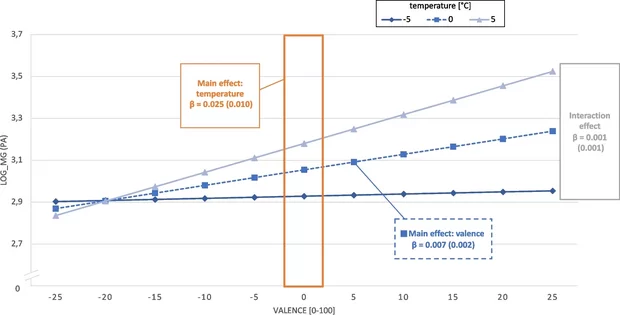
The first figure illustrates the association between affective valence and physical activity across varying temperature conditions. Overall, higher valence is associated with higher levels of physical activity, while temperature systematically moderates this relationship. Specifically, stronger positive associations are observed at warmer temperatures, reflected in steeper increases in activity with increasing valence.
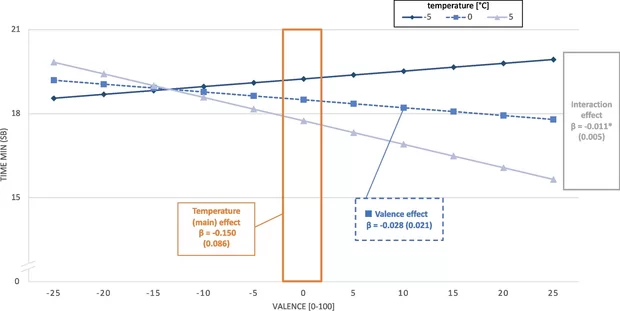
The second figure depicts the association between affective valence and sedentary behavior. Consistent with expectations, higher valence is generally associated with reduced sedentary time. However, this relationship is context-dependent, with attenuated associations under colder conditions and stronger reductions in sedentary behavior at higher temperatures.
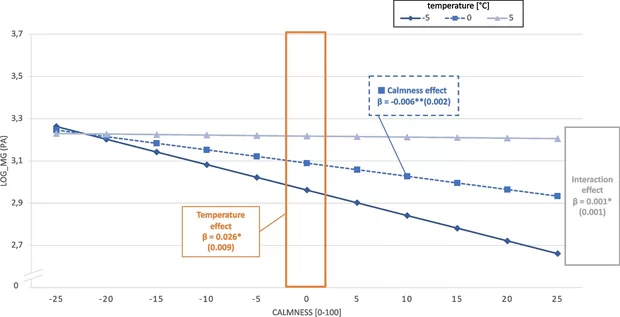
The third figure focuses on calmness and physical activity, showing that higher calmness is associated with lower levels of physical activity. Importantly, this association is again moderated by temperature, with stronger negative associations under colder conditions, whereas the relationship appears weaker or flattened at higher temperatures.
Taken together, the findings demonstrate that within-subject mood–behavior associations are highly context-dependent and vary systematically as a function of environmental conditions. By explicitly integrating objective weather data with wearable-derived behavioral measures, the study provides evidence that environmental context is a key moderator of affect–behavior dynamics. These results help explain previously observed heterogeneity in real-world mood–movement associations and underscore the importance of context-aware, wearable-based ambulatory assessment approaches in future research.
Across these projects, our research demonstrates how wearable devices and ambulatory assessment methods can be used to study within-subject dynamics of physical behavior and affective states as they unfold in everyday life. Both the systematic review and the empirical study highlight that mood–movement associations are dynamic, heterogeneous, and strongly context-dependent.
By synthesizing existing evidence and providing new empirical insights, this work shows that even short-term fluctuations in affect are meaningfully related to physical activity and sedentary behavior, while contextual factors, such as weather conditions, can systematically shape these associations.
Taken together, these projects illustrate the value of combining sensor-based measurements, real-time self-reports, and contextual information to move beyond laboratory settings and capture behavioral and affective processes under natural, real-world conditions.